Daggerheart ancestry: Katari. Player-facing.
OVERVIEW
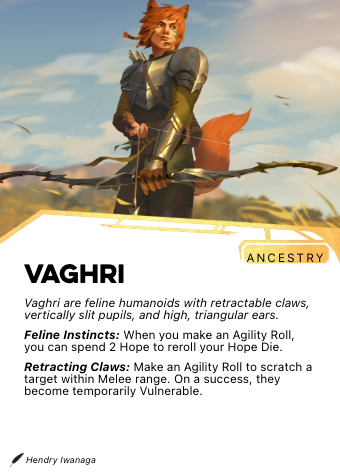
Vaghri (Katari) are feline humanoids with retractable claws, vertical pupils, and triangular ears set high on the head. Their whiskers assist navigation in near-darkness and crowded spaces, and their ears can rotate nearly 180 degrees to track sound independently of their head position. Some Vaghri are more pronouncedly feline — muzzle, dense fur, tail — while others are nearer to humanoid with primarily feline eyes and ears. About half carry a tail. Their fur and skin patterns span the full range of felid colorings: solids, stripes, spots, marbling, calico.
Vaghri stand between 3 and 6½ feet tall and live to around 150 years. They are found across Tarim-Shaiel in broadly distributed communities, without the geographic concentration that marks some other ancestries. Their hunting instincts are not separate from their social selves — Vaghri are simply people for whom the read on a room, the tracking of movement at the edge of perception, and the precise assessment of threat are natural functions rather than practiced skills.
They have a reputation for pride that is not entirely inaccurate. Vaghri do not perform humility they don't feel. They are also, among the peoples most frequently sought as companions and partners by those who understand what it means to have someone in their corner who will not flinch.
Ancestry Features
Vaghri hunting instincts are not separate from their social selves — the read on a room, the tracking of movement at the edge of perception, and the precise assessment of threat are natural functions rather than practiced skills. When a situation requires them to be fast, they are usually already moving.
Vaghri retractable claws are part of how they engage with the world at close range. Deployed in contact, they can create a vulnerability in an opponent that wasn't there before — a disruption precise enough to change how that opponent is able to defend themselves in the moments that follow.
HISTORICAL POSITION
Before the Liberation
Vaghri were never systematically enslaved in the way the Tulpar were. Their distributed nature made them difficult to consolidate; their instinctive threat-reading made enforced compliance expensive. Individual Vaghri served various imperial powers as guards, scouts, and specialists — some by contract, some under coercion, some by genuine choice. But no binding spell was ever designed to hold a population defined by its dispersal. The empire found it easier to employ Vaghri than to own them.
This meant that when the liberation came, most Vaghri experienced it differently than the peoples at the center of the event. Some were embedded in imperial military structures when those structures collapsed. Some were operating independently and watched the whole thing from positions of specific, tactical vantage. A smaller number were actively involved — the liberation's architects needed people who could move through imperial territory without being remembered, who could read the room and act on what they read before the opportunity closed. Vaghri who chose that work did not choose it for ideology. They chose it because the problem was solvable and they could see how.
Vaghri oral tradition does not carry the liberation as its central event the way Tulpar tradition does. It carries it as a specific set of memories: what was seen, who was where, what certain people did in certain moments. The Vaghri communities whose members were present hold those accounts with precision. The communities whose members were elsewhere hold a general understanding that something large happened, and a wariness about the confident claims of those who were at its center.
The Aftermath: What Pride Requires
The chaos following the liberation was, for Vaghri, primarily a problem of evaluation. The old structures were gone; new ones were forming rapidly and unreliably. Every faction presenting itself as a legitimate power required assessment. Every alliance offered required consideration of what it would actually cost. Vaghri communities that moved quickly into obvious alignments often found themselves holding obligations to structures that didn't survive the decade.
Vaghri communities that waited, evaluated, and moved deliberately fared better — not always materially, but in the sense that mattered to them: the relationships they committed to were ones they had actually chosen, with people they had actually assessed. Pride, for Vaghri, is not about prestige. It is about accuracy. It is about not pretending to trust what you haven't evaluated, not performing deference to what you haven't found worthy, not claiming obligations you don't intend to honor. The chaos years rewarded this orientation.
This is part of why Vaghri are distributed across Tarim-Shaiel without a unified homeland or confederation. Every attempt to consolidate Vaghri communities under a single political structure has failed — not because Vaghri cannot cooperate, but because Vaghri will not give their cooperation to an abstraction. They give it to specific people, for specific reasons, after specific evaluation. No one has yet built an institution patient enough to earn it at scale.
The Flowering: The Martial Academies
As the world stabilized into the era historians call the Flowering, Vaghri developed the contribution they are most consistently recognized for across Tarim-Shaiel: the individual martial master and the apprenticeship tradition that surrounds them.
Vaghri martial traditions are not multi-style in the Tulpar sense. They do not collect techniques from other peoples and synthesize them into a comprehensive system. They develop from within — building on the specific movement possibilities of a Vaghri body, the specific perceptual advantages of vertical pupils and rotating ears, the specific ways that a Vaghri in motion reads differently from anything else in motion. The result is a fighting tradition that is difficult to study second-hand and very difficult to counter unless you have spent time with a Vaghri teacher.
Those teachers exist, and they accept students from any ancestry. The apprenticeships are long, deeply personal, and do not follow a curriculum. A Vaghri master teaches what the student can receive, when they can receive it. Former students of notable masters carry that lineage as a significant part of their identity — not as a credential, but as a relationship they are still in.
The Flowering also saw Vaghri communities become recognized contributors to the philosophical traditions of the era. Their contribution was specific: not systematic philosophy in the Kuhban archival mode, but observation-based practices. A Vaghri teacher's thought tends toward the concrete and the relational — the relationship between stillness and movement, between what can be perceived and what is actually there, between what you owe and what you are owed. These observations entered the broader intellectual culture of the Silk Road through students, through trade contacts, and through the Vaghri tendency to say what they see clearly and without softening.
CULTURAL CHARACTERISTICS
Pride as Accuracy
Vaghri pride is frequently misread as arrogance. The distinction matters: arrogance is inflated self-assessment, and Vaghri are as capable of inflated self-assessment as anyone. But the cultural norm is the opposite — precision. A Vaghri who claims capability they don't have embarrasses themselves in a way that social deflection cannot repair. A Vaghri who performs deference they don't feel creates a false record of a relationship that doesn't exist.
The practical consequence is that when a Vaghri tells you something about themselves — or about you — you can generally trust that they have evaluated it before saying it. This makes Vaghri assessments valuable and Vaghri social relationships clarifying. It also makes early interactions with Vaghri feel cooler than the relationship eventually becomes, because the warmth arrives after assessment, not instead of it.
The Seen
When a Vaghri has evaluated someone and found them worth genuine engagement, there is a specific quality of attention that shifts. Vaghri call this being seen — not a ceremony or a formal acknowledgment, just the moment when the held-back assessment gives way to actual presence. People who have experienced it describe it as being looked at fully for the first time. People who have experienced it and then had it withdrawn describe the withdrawal as one of the more disorienting things that has happened to them.
Being seen does not mean being liked. It means being accurately perceived, which is a form of respect that Vaghri offer deliberately and withdraw for specific cause. The Vaghri who has decided to see you will notice things about you that you did not know you were showing. This is either invaluable or uncomfortable depending entirely on what is there to be seen.
Memory and Ledger
Vaghri do not forget. This is not a cultural value — it is a straightforward description. A Vaghri who was wronged by someone's grandparent carries that account. A Vaghri who was helped by someone's ancestor carries that too. The ledger is not vindictive; it is accurate. Debts in both directions are held with equal precision.
The practical consequence is that a Vaghri community's first encounter with a stranger includes a rapid, mostly invisible assessment: do I know anything about who these people are? Often the answer is no. But sometimes the answer is yes, and the Vaghri's behavior will be shaped by an account that the stranger may not know exists. It is considered basic courtesy in communities with significant Vaghri populations to, when introducing yourself, mention who your family is and where you're from — because that information may already mean something to the Vaghri in the room, in ways they won't necessarily explain.
The Lack of a Homeland
Vaghri have no unified political entity, no central homeland, no confederation to speak for them. This is not mourned within Vaghri communities the way it is sometimes interpreted from outside. Vaghri belonging is personal and specific — to communities they have assessed and chosen, to teachers and students whose relationships extend across decades, to the few people who have earned the full quality of their attention. These bonds are not lesser for lacking political infrastructure. They are, from the Vaghri perspective, more reliable.
What Vaghri do not have is the kind of institutional backing that makes large-scale collective action possible. When Vaghri communities face threats, they respond as individuals and small groups who happen to be aligned — which is sometimes sufficient and sometimes not. The communities that have survived longest in difficult regions are those that developed informal alliance networks with neighboring peoples: not political alliances, but the specific understandings that develop between people who have been neighbors long enough to actually know each other.
RELATIONS WITH OTHER ANCESTRIES
Respectful distance that tends toward warmth over time. Shared respect for martial tradition provides initial common ground; the differences in approach — Tulpar collecting traditions widely, Vaghri developing from within — become interesting rather than divisive once the initial assessment has happened. Weapon technique exchanges occur occasionally. They are taken seriously by both parties.
Overlapping space and complementary orientation. Vanara maintain the roads; Vaghri are present everywhere along them. Both take their obligations seriously. Both have a relationship to pride that the other recognizes, even if expressed differently. Long-term partnerships between individual Vanara and Vaghri are not uncommon and tend to be among the more durable relationships either party forms.
Genuine affinity with interesting texture. Rahban community-building appeals to Vaghri, who value specific deep bonds over broad shallow ones. The Rahban practice of maintaining relationships across distance resonates with the Vaghri ledger — though a Vaghri's ledger and a Rahban's correspondence network are different instruments for similar purposes. Misunderstandings occur when Rahban interpret Vaghri reserve as coolness; they usually resolve once the Vaghri has finished assessing.
Mutual professional respect at mountain passes and waypoints. Both peoples move with a quality of attention that the other recognizes. The Pari-Kin facility with thresholds and the Vaghri facility with reading situations combine practically into effective partnership in uncertain terrain. Neither is especially interested in the other's inner life, which makes the partnership comfortable.
Entirely individual. Vaghri assess each human community on its own terms, carrying the ledger of what specific humans have done. In regions with long histories of Vaghri-human cooperation, relationships are warm and layered. In regions where the accounts are difficult, the difficulty is specific and named rather than general.
PLAYER CHARACTER HOOKS
Questions for a Vaghri (Katari) PC
1. What did you evaluate and find worthy — and was that surprising? Vaghri assessment is supposed to be accurate, not predetermined. What met your assessment in a way you didn't expect?
2. What is in the ledger — on both sides? What do you owe, and what are you owed? These accounts shape every room you walk into.
3. Who taught you, and what does that relationship still require of you? A Vaghri apprenticeship is not a curriculum — it is a relationship that continues. What does your teacher still expect? What do you still owe them the opportunity to give?
Tarim-Shaiel · Daggerheart Campaign · 2026