Daggerheart ancestry: Human. Player-facing.
OVERVIEW
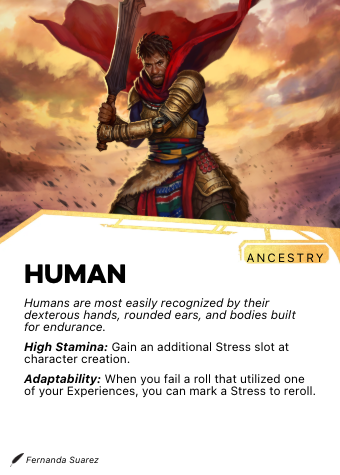
Humans are the most widely distributed of Tarim-Shaiel's peoples, found in every region, every kind of settlement, and every kind of role. Their average height runs from just under 5 feet to about 6½ feet, with a breadth of builds that spans the full range from light and quick to broad and grounded. They adjust to new climates and conditions with a speed that other ancestries find remarkable; a human who has lived five years somewhere tends to look and move like someone who belongs there.
They live for about 100 years, shorter than many of the peoples they share Tarim-Shaiel with. This does not appear to limit them. Humans are not defined by a single cultural tradition, a characteristic geography, or a particular appearance — they are defined, to the extent any single thing can define them, by the fact that they adapt, and that they do it quickly.
Humans carry their experiences in the way they move. A human who has trained at something for ten years looks different from one who hasn't. The body records what the person has chosen to put into it, and most of the peoples of Tarim-Shaiel have learned to read those records.
Ancestry Features
Human bodies are built for endurance rather than peak output — a design that does not impress in a single moment but accumulates over time into something other ancestries find difficult to match. A human who has decided not to stop is, practically speaking, difficult to stop.
Humans adjust to new climates and conditions with a speed that other ancestries find remarkable. A human who has lived five years somewhere tends to look and move like someone who belongs there. When a method fails, they do not insist on it — they find another way, and they do it faster than most.
HISTORICAL POSITION
The Empire and What It Means
A thousand years ago, the empire that controlled the Silk Road was a human empire. Its administrative class was human; its military command was human; its bureaucratic systems encoded human authority. The binding spells that held the Tulpar (Orc) in bondage were sustained by human political will.
This is the fact that sits at the center of human history in Tarim-Shaiel, and every human character relates to it differently — which is itself the most characteristically human response to a historical fact. Some human communities have spent a thousand years processing the weight of what their ancestors built and sustained. Others have spent a thousand years revising that history into something more comfortable. Most have simply lived their lives in the world the liberation created, neither claiming the guilt nor owning the inheritance.
Not all humans were enslavers. The empire was human-led but not uniformly human-benefiting — subject populations within the empire included humans from conquered regions, humans in the lower administrative tiers, humans in the farming communities who sent their grain to imperial cities and received little in return. The liberation was not a human crime against everyone else. It was a specific political system's crime, run by specific humans, that ended — imperfectly, violently, at enormous cost — a thousand years ago.
The ten generations between then and now are genuinely significant. Whatever a human character's great-great-great-great-great-great-great-great-great-grandparents did, it is history. The question is what relationship this specific person has chosen — or inherited, or rejected — with that history.
The Collapse and the Successor Kingdoms
When the liberation came and the imperial structure failed, the human response was not unified. It could not be — human communities were scattered across the entire Silk Road, with vastly different relationships to the imperial center.
Former administrative families became warlords, diplomats, or refugees depending on what they had access to and how quickly they could adapt. The merchant class pivoted faster than most — trade continued even when governance didn't, and human merchants who could work with the emerging Tulpar (Orc) clans and Rahban (Halfling) networks found themselves well-positioned in the new order. Rural communities largely kept farming. The political catastrophe of empire collapse was, for most humans, an event that reached them at a remove and then was absorbed into the longer rhythms of ordinary life.
Three major successor kingdoms eventually consolidated from the chaos in the east — distinct dynasties with sophisticated bureaucracies, exam-based civil service systems, and a highly developed aesthetic culture that tends to view the old empire as a cautionary tale it has decisively moved beyond. These eastern kingdoms carry the most direct administrative inheritance from the empire, and consequently the most complicated feelings about it; Tulpar communities living nearby have opinions about how thoroughly that reckoning has actually happened. Further south, the great sub-continental principalities pursued a different path — less interested in imperial continuity than in maritime trade and religious scholarship, more pluralist in practice if not always in theory. To the north, the steppe confederacies — horse-peoples who the empire never fully absorbed and never stopped trying to — emerged from the chaos as significant powers in their own right, with a relationship to the old empire that is mostly contemptuous: we were never conquered. We are not implicated. Whether that assessment is entirely accurate is a matter some Tulpar historians dispute quietly.
Each of these traditions has spent a thousand years deciding what to do with the fact of the old empire: some human cultures have processed it as a source of lasting shame that shapes how they engage with Tulpar communities today; others have reconstructed it as "complicated history" in ways that Tulpar find infuriating; most have landed somewhere in the middle, carrying the weight without having resolved what to do with it. The steppe peoples largely decline the question.
The Long Peace and the Cosmopolitan Present
The world that emerged from the chaos is one where humans are everywhere and dominant in no specific way. The successor kingdoms are significant powers, but they are not the empire — they compete with the Tulpar (Orc) Confederation, the Kuhban (Dwarf) mountain leagues, the Jivar (Goblin) free cities, and dozens of other factions on roughly equal terms. Human cultural output — art, scholarship, philosophy, commerce — is high-volume and widely distributed rather than centralized and authoritative.
This has produced, in the major trade cities, a cosmopolitan human identity that is genuinely different from anything the empire produced: multi-lingual, inter-married across ancestries, more interested in what someone can do than where they come from. Whether this represents genuine transformation or comfortable erasure of an unresolved past is a question that different human communities answer differently.
The short lifespan matters here. Ten human generations have passed since the liberation. Living humans have no personal memory of the empire — only inherited stories, some honest, many not. For Tulpar communities who maintain the Chain Chronicles, this creates real friction: they have records. Humans have narratives. The two are not always compatible.
CULTURAL CHARACTERISTICS
The Shape of Adaptation
Humans adapt. This is the one thing that holds across every human community in Tarim-Shaiel, and it manifests in ways that range from admirable to troubling depending on what is being adapted to.
A human family that settles in a Tulpar (Orc) merchant city for three generations will, by the fourth, keep Liberation Day. Not always with full understanding of what they are marking, but with genuine participation. A human who apprentices to a Vanara (Simiah) martial academy for a decade will carry Vanara patterns of movement for the rest of their life. A human who learns to read from a Kuhban (Dwarf) archive-keeper will organize information the way that archive-keeper organized it, in ways they may not notice for years.
This is not performance or imitation. It is how human beings actually change in response to sustained contact — faster and more thoroughly than most other ancestries, and in ways that become genuine rather than cosmetic with time. The people of Tarim-Shaiel who have lived alongside humans long enough have learned to read the accumulated influences in how a human holds themselves.
The shadow side is that this same adaptability can mean absorbing the values of whatever context a human finds themselves in without examining them. A human raised in a community that has revised imperial history into something flattering will carry that revision. A human who has never been challenged on an inherited assumption may not know it is an assumption. Adaptability is not the same as wisdom, and Tarim-Shaiel has no shortage of humans who have adapted very efficiently to things that deserved more resistance.
No Single Story
Unlike almost every other ancestry in Tarim-Shaiel, humans do not have a shared event that organizes cultural memory. The Tulpar (Orc) have the liberation. The Rahban (Halfling) have the Truce. The Pari-Kin (Faun) have their relationship to specific sacred places. Humans have everything and nothing — too many events, too many communities, too many competing versions of what matters.
This means human identity, more than any other ancestry's, is local. A human from the eastern successor kingdoms carries different assumptions, aesthetics, and obligations than a human from the Tarim Basin oasis cities, who carries different ones than a human from the mountain borderlands, who carries different ones than someone raised in a steppe confederacy where a tent and a horse are the only permanent things. When these humans meet, they share an ancestry and often find they share very little else. They adapt — find common ground, adjust, proceed — but the common ground is negotiated, not inherited.
RELATIONS WITH OTHER ANCESTRIES
Every ancestry in Tarim-Shaiel has a relationship with humans. This is unavoidable — humans are the most numerous people in most places, and the empire that shaped the current world was theirs. What that relationship looks like varies by region, history, and individual. The entries below describe the general shape; the specific texture depends entirely on which humans and which community.
The most historically fraught relationship in Tarim-Shaiel. Tulpar communities that maintain Chain Chronicles have specific records of specific humans — what was done, by whom, when. This is not abstract. For Tulpar, the empire is not distant history; it is documented fact passed through forty generations of oral and written tradition. Individual human-Tulpar relationships can be warm, and many are — but they are warm in full awareness of what sits underneath. Humans who want genuine connection with Tulpar communities rather than comfortable distance need to be willing to hear what the records say.
Deeply embedded and generally warm. Rahban communities are woven through human cities and settlements across Tarim-Shaiel, and the thousand years of shared habitation has produced genuine mutual understanding in most regions. Rahban remember which human communities showed up to help during the chaos period, and which didn't — and they keep those records in the relational way that Rahban keep everything.
Respectful and somewhat formal. Kuhban chronicle-keepers have objective records of the imperial era, and they are not shy about sharing them when asked — or when they think they should be. Human-Kuhban relationships in scholarly contexts can be productive and occasionally prickly. In trade contexts, they are reliable. Kuhban assess humans as individuals with a fair amount of pragmatic goodwill, and will note with precision when that goodwill has been earned or forfeited.
The teaching relationship. More humans have studied at Vanara (Simiah) academies than any other ancestry, purely by weight of numbers, and the Vanara have complex feelings about this — appreciation for the resources it represents, occasional frustration with students who want credentials without depth. The best Vanara-human relationships are those that became genuine over the long duration of an apprenticeship. The worst are those where the human left before earning what they were reaching for.
Pragmatic alignment. Both peoples built significant presences in the Silk Road's commercial culture, and both tend to evaluate each other on demonstrated capability rather than ancestry. Jivar communities have long memories for which humans were reliable partners and which weren't — their ledgers are commercial rather than historical, but they are kept with equal precision.
Variable by region, consistent in one respect: Gavar communities remember exactly what happened at their thresholds during the liberation and chaos period. The humans who held their covenants are remembered as such. The humans who didn't are also remembered. This is not a grudge — it is simply an accurate record that shapes how trust is extended in the present.
The most opaque relationship on the Silk Road, and the one humans are most likely to have strong opinions about without reliable information. Serenvar enclaves predate most human settlements and outlast most human institutions; they have been present through the full arc of the empire, the liberation, the chaos, and the Long Peace, watching all of it from positions they have not explained. Human speculation runs in every direction. Some say the Serenvar knew the empire would fall long before anyone else did — that certain enclave locations shifted in the years before the liberation in ways that in retrospect look deliberate. Others say the Serenvar actively influenced the liberation in ways that were never acknowledged, for reasons that served the enclaves rather than the Tulpar. Others say they simply watch, and wait, and are waiting still for something that has not happened yet. The enclaves do not comment on any of these theories. The humans in settlements nearest the enclaves tend to have the most specific rumors and the least certainty about which ones are true.
PLAYER CHARACTER HOOKS
Questions for a Human PC
1. Where are you from, and what does that place believe about the empire? Human communities have spent a thousand years deciding what to do with that history — some with more honesty than others. What story did you grow up inside, and how much of it have you tested against what other people remember?
2. What have you adapted to that you didn't expect to? Humans change in response to sustained contact with people, places, and practices. Something has shaped you — left marks in how you move, what you value, how you read a room. What was it, and do you carry it consciously or did it simply become part of you?
3. Who are you to the people who have reason to distrust humans? This is the question every human in Tarim-Shaiel answers eventually, whether they choose to or not. Some answer it with avoidance, some with guilt, some with genuine engagement. What is your answer — and is it one you arrived at yourself, or one you inherited?
Character Concepts
- The archive-keeper's apprentice: A human who spent years working in a Kuhban (Dwarf) historical archive, reading the records of the imperial era without the softening that human oral tradition applies to them. They know what the documents say. They are still deciding what to do with that knowledge.
- The Silk Road merchant's child: Born into a multi-species trading household in a cosmopolitan oasis city, raised by people from four different ancestries, at home everywhere and distinctly from nowhere in particular. Their human ancestry is one fact among many rather than the organizing principle of their identity.
- The successor kingdom official: Trained in the examination systems of one of the eastern human dynasties — rigorous, meritocratic, shaped by bureaucratic tradition that traces back to the imperial era without quite acknowledging what it traces back to. They are competent, literate, and carrying assumptions they have not yet examined.
- The community that helped: Descended from a human settlement that sheltered Tulpar (Orc) refugees during the chaos period, at real cost to themselves. This history is kept by both communities. The Tulpar clan histories name the settlement. The human's family knows they are named there, and what that means.
Tarim-Shaiel · Daggerheart Campaign · 2026