OVERVIEW
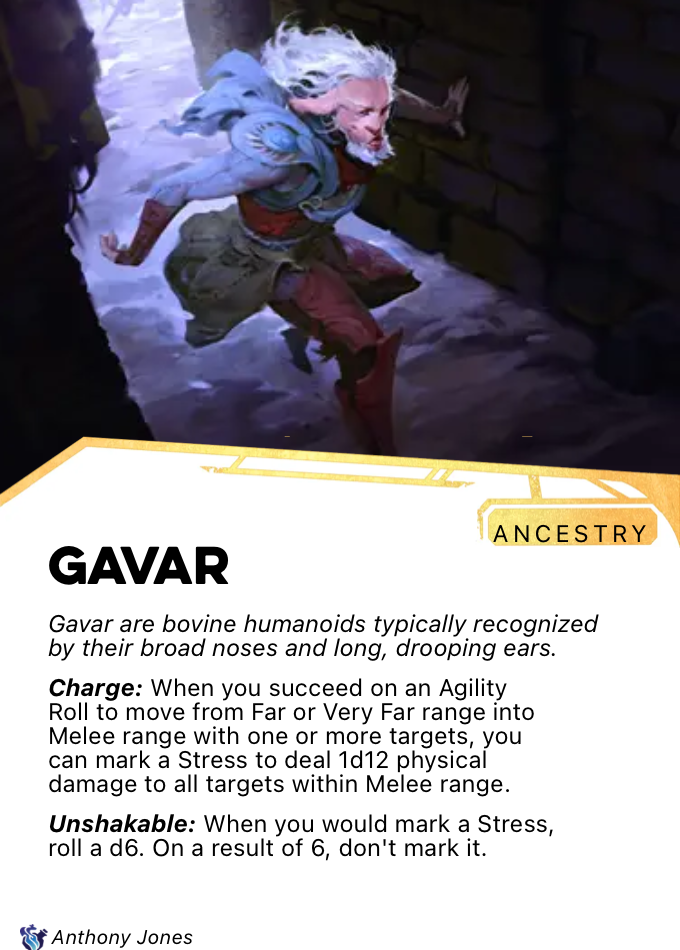
Gavar (Firbolg) are bovine humanoids recognized by their broad frames, fur-covered bodies, and horns. Their faces range from humanoid with subtle caprine features to fully bull-headed; those with the fullest bovine aspect are called Minaurid within Gavar communities. Their fur runs in earthy tones — deep brown, black, cream, occasional ash — and their horns can be modest and swept-back or dramatically curved. On average, Gavar stand between 5 and 7 feet and are consistently strong regardless of age.
Gavar communities are found throughout Tarim-Shaiel at thresholds: crossroads, river fords, city gates, mountain passes. They have kept these places for generations and are associated with oaths, agricultural contracts, and the marking of seasons. Their presence at a boundary is generally understood as a guarantee that the boundary will be respected.
They are not quick to commit. They are equally not quick to change direction once committed. This makes them among the most reliable people in Tarim-Shaiel when they give their word — and occasionally immovable when they have decided they disagree with something. Their charges, in the literal physical sense, are legendary.
HISTORICAL POSITION
Before the Liberation
Gavar presence at Tarim-Shaiel's significant thresholds predates written records. The threshold-keeping role is not a post-liberation adaptation; it is something Gavar communities understand as their original function. River crossings, mountain passes, city gates, the edges of cultivated land — these are Gavar places in a way that is older than most of the polities that have tried to claim them.
The association with agricultural cycles runs equally deep. Gavar communities have marked the turning of seasons at the same sites for longer than anyone can reliably document. The blessing of a Gavar elder at planting or harvest is not ceremonial in the regions where it is practiced — it is considered genuinely efficacious.
The Liberation Era
Gavar communities were among the most stable presences during the chaos of the liberation. Their threshold-keeping function became critically important: with established order collapsed and populations moving across Tarim-Shaiel in large numbers, the Gavar-held crossings were among the few places where safe passage could be reliably expected.
This was not effortless. Some Gavar communities were pressured by former imperial powers to restrict passage. Some complied. The communities that held their threshold-guarantees regardless of pressure are remembered; the ones that didn't are also remembered. The liberation era produced lasting divisions within Gavar culture about what the threshold-keeping obligation actually requires.
The Modern Era
Modern Gavar communities remain anchored to their thresholds but are not isolated at them. Major Gavar families hold significant economic weight through their control of crossing fees, agricultural contracts, and the various services a reliable threshold-keeper can provide. The Minaurid — those with the fullest bovine aspect — occupy a particular position of cultural authority within most Gavar communities, though this is contested in some regions.
"The crossing does not care who you were when you arrived. It only asks whether you will hold your word at the other side."
CULTURAL CHARACTERISTICS
The Threshold Covenant
Gavar do not merely work at crossings — they understand themselves as bound to them. The threshold covenant is the central institution of Gavar culture: a commitment, made by a community to a specific place, that any who come to that threshold in genuine need will not be turned away. The terms of the covenant vary by community and threshold. The commitment itself does not.
Breaking the threshold covenant — refusing passage to someone who meets the community's stated terms — is among the most serious acts in Gavar ethical reckoning. The liberation-era communities that did so under imperial pressure have not been fully forgiven, several hundred years later.
Deliberate Commitment
Gavar do not make decisions quickly. This is not incapacity — it is a principled approach to commitment. A Gavar who agrees to something has considered it. A Gavar who says they will do something has decided, fully, that they will do it. The cultural expectation is that commitments are permanent until formally and explicitly renegotiated.
This makes Gavar difficult to rush, and makes rushed decisions made by Gavar rare. When a Gavar moves quickly — in negotiation, in combat, in any domain — it means they already made the relevant decision some time ago and have simply been waiting for the right moment.
The Minaurid
Gavar whose faces are fully bull-headed — the Minaurid — are not a separate people but a distinct expression within Gavar communities. In most regions, the Minaurid carry particular cultural authority: they are more immediately associated with the sacred dimension of the threshold-keeping role, and their physical presence at a boundary carries additional symbolic weight.
The authority of the Minaurid is not universal. In some Gavar communities it is contested by more humanoid-featured members who argue that the bovine aspect is biological variation, not spiritual designation. This is an ongoing internal debate, not a resolved one.
Seasonal Observance
Gavar communities mark the agricultural calendar with ceremonies that are among the oldest continuous practices in Tarim-Shaiel. The specific forms vary enormously by region — Gavar who settled in different climates adapted their observances to local growing seasons — but the underlying structure is consistent: acknowledgment of what the land asks, what the community owes it, and what has been given and received.
Non-Gavar who attend these ceremonies are welcome in most communities. They are asked to be present rather than to understand.
ECONOMIC AND SOCIAL ROLE
Threshold management, crossing fees and services, agricultural contract-holding, seasonal ceremony, oath-witnessing.
Gavar-held crossings generate reliable income through fees, but the more significant economic value is in the trust they represent. A merchant who crosses a Gavar threshold has implicitly received a guarantee of safety. The reputational cost to a Gavar community of violating that guarantee is severe enough that it almost never happens — which is exactly why the guarantee is worth something.
When significant agreements are made in regions with established Gavar communities, it is common practice to have a Gavar elder present as witness. A Gavar-witnessed oath carries weight in most courts in Tarim-Shaiel, not as legal mechanism but as social fact: breaking an oath made before a Gavar witness will be remembered, and the Gavar community will know.
Gavar families hold the contracts for planting rights, water access, and harvest sharing across significant portions of Tarim-Shaiel's agricultural zones. These relationships are often multi-generational, predating current polities.
FEATURES IN THE WORLD
What Daggerheart's Firbolg mechanics mean inside Tarim-Shaiel — no game-system references.
Gavar strength is consistent across their lifespan in a way that is unusual even among large ancestries. An elder Gavar is not weaker than a young one. This is understood within Gavar culture as the body holding what the threshold-keeper needs for as long as the keeper stands.
Gavar can move with explosive force when they decide to. The decision is the critical element — a Gavar charge is the physical expression of a commitment already fully made. The people of Tarim-Shaiel who have seen one tend to describe not so much the impact as the moment just before it, when the Gavar stopped considering and simply became what they had decided to be.
Some Gavar describe a capacity to communicate with the land they are committed to — to receive something from the threshold that tells them about its condition, its history, what has passed through it. This is not universally reported and is not well understood even within Gavar communities. It manifests most clearly at places where a Gavar has kept threshold for a long time.
RELATIONS WITH OTHER ANCESTRIES
Natural partners at mountain thresholds. Both peoples understand guardianship as an obligation rather than a commercial arrangement. The working division — Gavar hold the gates, Vanara hold the roads — has evolved over centuries at specific shared sites. There is genuine mutual respect, and occasional genuine disagreement about where one community's responsibility ends and the other's begins.
Complex. Tulpar clans passing through the chaos period found Gavar crossings both essential and occasionally contested. The communities that held their covenants during the liberation are well-regarded in Tulpar clan histories. The communities that didn't are not. Modern Tulpar-Gavar relationships carry the weight of both memories.
Varied by region. In agricultural zones where Gavar families have held contracts for generations, the relationships with local human communities are old and layered. In cities, Gavar are more unusual presences — functional but less culturally embedded. The city Gavar tends to be someone who left a threshold, for reasons that are always their own.
Mutual respect for the weight of spoken commitment. When both a Gavar and a Div-Born say they will do something, the people around them tend to believe it. This shared credibility creates natural working relationships in contexts where reliable parties are needed.
PLAYER CHARACTER HOOKS
Questions for a Gavar (Firbolg) PC
1. What threshold did you leave, and why? Gavar are defined by the places they hold. A Gavar who is traveling — who is here, wherever here is — has left something. That leaving has a reason, and the reason matters.
2. What commitment are you still carrying? Gavar commitments do not dissolve when circumstances change. What did you agree to, or decide, that you are still bound by? Does the other party know you still consider it active?
3. Are you Minaurid, and what does that mean to you in practice? If you carry the full bovine aspect, you carry the cultural weight of it — expected authority, expected significance. If you don't, you may have opinions about the tradition. Either way, the question of what the Minaurid designation actually means is not settled.
Character Concepts
- The threshold-keeper whose threshold was destroyed: A Gavar who held a crossing that no longer exists — the bridge collapsed, the ford silted over, the city gate was torn down. The covenant doesn't have anywhere to land anymore. What does a threshold-keeper do when the threshold is gone?
- The one who chose wrong during the liberation: A Gavar from a family that closed its threshold during the liberation under imperial pressure. That history follows them. They have decided what they think of it. Not everyone they meet has to agree.
- The Minaurid who left the ceremonial role: A Gavar whose full bovine aspect marked them for community authority they didn't want, or didn't want the way it was offered. They left the threshold that expected that of them. They are still working out who they are when nobody is looking at them as a symbol.