OVERVIEW
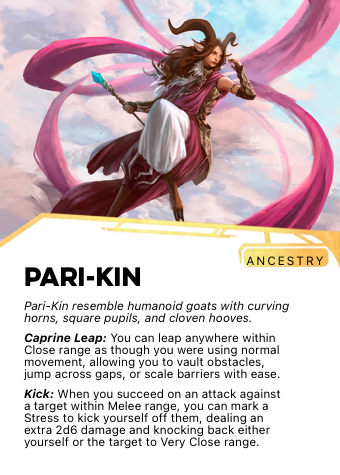
Pari-Kin (Faun) have a goatlike lower body and broadly humanoid upper body, with horns, cloven hooves, and horizontal pupils. Their lower bodies are covered in dense fur. Horn shapes range from modest backward curves to full dramatic spirals, and ear shapes vary similarly. They stand between 4 and 6½ feet tall, though posture plays an outsized role in how they carry that height — Pari-Kin can appear considerably taller or shorter depending on how they choose to hold themselves.
They are found most commonly in the highland regions of Tarim-Shaiel and along mountain routes, where they have long served as guides and threshold-keepers. They have a notable ease with barriers — physical, social, and otherwise — that can be disorienting to people who prefer boundaries to stay fixed. Their leaping ability is practical rather than showy; they treat gaps and walls as minor inconveniences.
Pari-Kin communities tend to be small and highly mobile. They maintain longer histories with specific places — passes, peaks, sacred waypoints — than with nations or organizations.
HISTORICAL POSITION
The Pari Lineage
Pari-Kin trace their ancestry to the Pari — beings associated in the oldest Tarim-Shaiel traditions with the spaces between: between worlds, between seasons, between the living and whatever lies beyond. The Pari are not uniformly benevolent in these traditions, nor uniformly dangerous. They are liminal, and liminal things resist simple categorization.
The Pari-Kin are not the Pari. They are descendants of interactions between Pari and mortal peoples, filtered through many generations, shaped by Tarim-Shaiel's physical world in ways their ancestors were not. The Pari themselves are rarely seen. The Pari-Kin are here.
Before and During the Liberation
Pari-Kin communities have always been small and mobile, and this protected them from some of the disruption that the liberation brought to more settled peoples. They were not enslaved in significant numbers because they are genuinely difficult to contain — not through aggression, but because their ease with barriers makes enforced boundaries unreliable. Imperial systems that tried to bind Pari-Kin communities generally found the communities elsewhere by the time the enforcement arrived.
During the liberation itself, Pari-Kin served as messengers, scouts, and in some cases extractors of people from situations that should have been inescapable. The records are fragmentary — Pari-Kin communities do not keep comprehensive archives in the way settled peoples do — but the liberation-era reputation for appearing where they were needed and disappearing afterward is consistent across multiple sources.
The Modern Era
Modern Pari-Kin remain highland-centered and mobile. Their communities are harder to locate on a map than most — they maintain relationships with specific places rather than permanent settlements, and their sense of home is more calendrical than geographical. Where they are now depends on what time of year it is.
"The wall does not ask us to stop. It only waits to see if we will."
CULTURAL CHARACTERISTICS
Place Over Nation
Pari-Kin identity attaches to specific physical locations rather than to political entities or ancestral bloodlines. A Pari-Kin community may maintain relationship with a particular peak, pass, or sacred waypoint across hundreds of years, cycling through it seasonally without ever claiming ownership of it.
This creates a form of continuity that polities find difficult to interrupt. You cannot conquer a Pari-Kin community's relationship to a place by changing who governs the region. The community will return when the season requires it, regardless of what the current administration thinks about the matter.
The Ease with Barriers
Pari-Kin relationship to physical and social barriers is genuinely different from most peoples'. Physical obstacles — walls, gaps, difficult terrain — are problems to be solved through movement rather than confronted directly. Social obstacles receive similar treatment: a Pari-Kin who wants to enter a space they are not invited into will find the available gap rather than demanding the door.
This is not deception. It is a different intuition about what barriers mean. Pari-Kin generally understand a barrier as a question rather than a prohibition: can you get through this? The answer, for a Pari-Kin, is usually yes.
Peoples who rely on barriers for security tend to find Pari-Kin unsettling even when the Pari-Kin have no hostile intent. This is a consistent feature of the relationship.
Small Community, Deep Bond
Pari-Kin communities are small by necessity — their mobility requires it, and their seasonal patterns work best with groups that can move quickly and leave light footprints. Within these small communities, bonds are deep and obligations are serious. A Pari-Kin community that has accepted someone — of any ancestry — as one of their own will not easily discard them.
This makes Pari-Kin trust significant when it is given. It also makes Pari-Kin isolation significant when it is chosen. A Pari-Kin who is traveling alone has either left a community or not yet found one.
Seasonal Time
Pari-Kin mark time primarily by season and by the specific cycle of places they maintain relationship with. Their sense of history is spatial and cyclical rather than linear: events are remembered in terms of where they happened and at what point in the cycle, rather than in years from a fixed point.
This can make communication with Pari-Kin about historical matters disorienting for peoples who organize time linearly. A Pari-Kin account of something that happened two hundred years ago will be precise about location and season and atmospheric condition, and may offer no information that maps onto the calendar systems of Tarim-Shaiel's settled peoples.
ECONOMIC AND SOCIAL ROLE
Highland guidance, threshold-keeping at sacred waypoints, message-carrying across difficult terrain, extraction and evasion in crisis situations.
Pari-Kin knowledge of highland terrain is detailed and personal in the way that only comes from repeated traversal over long periods. They know not just the routes but the conditions of the routes across seasons, and they carry this knowledge in their bodies rather than in documents.
Pari-Kin communities are the primary keepers of many of Tarim-Shaiel's highland sacred sites — not in a priestly sense, but in the sense of being the people who return regularly, maintain the site, and remember what it is for. The knowledge of what these places mean is often held primarily by Pari-Kin.
In conflicts and emergencies, Pari-Kin ability to move through contested terrain and across barriers makes them valued for tasks that require getting someone or something from one place to another when the direct path is blocked. This has historical precedent from the liberation era and has continued in various forms since.
FEATURES IN THE WORLD
Pari-Kin leaping ability is a physical fact that informs everything about how they move through the world. It is not a special technique — it is simply how Pari-Kin bodies work. The gaps and ascents that present obstacles to other peoples are, to a Pari-Kin, features of terrain to be read and used.
Some Pari-Kin describe an awareness of boundaries and barriers that goes beyond physical perception — an intuition for where the permeable points are, in walls, in social situations, in the invisible lines that mark one kind of space from another. This is reported inconsistently and is not well understood, but it is accepted within Pari-Kin communities as a genuine if irregular trait of the lineage.
The connection to Pari ancestry manifests differently in different Pari-Kin individuals. Some carry it as a physical ease with liminal spaces; others carry something that feels more like a pull toward the between-places, an awareness of thresholds that is more cosmological than practical. The communities do not distinguish sharply between these expressions.
RELATIONS WITH OTHER ANCESTRIES
Overlapping territory, different function. Both peoples maintain relationships with mountain routes and highland passes. Vanara hold the roads institutionally; Pari-Kin hold the peaks and the sacred waypoints that the roads serve. The relationship is generally respectful at the working level and occasionally tense at the level of who knows what a particular place means.
A useful pairing at major threshold sites. Gavar hold the formal crossing; Pari-Kin know the informal routes. These are not competing functions. Communities that have learned to coordinate them have the most complete coverage of their territory.
Variable. Pari-Kin ease with barriers makes some humans uncomfortable regardless of intent. Human communities that have long experience with Pari-Kin neighbors tend to be more relaxed about it. Human communities encountering Pari-Kin for the first time sometimes react to the barrier-ease as threatening even when nothing threatening is happening.
An unusual affinity. Both peoples maintain relationships with places rather than nations, and both peoples hold knowledge that does not fit neatly into the record-keeping systems of settled cultures. Pari-Kin and Khavar communities sometimes winter together in regions where their territories overlap, and the combination of Khavar death-memory and Pari-Kin place-memory produces historical knowledge that neither community holds alone.
PLAYER CHARACTER HOOKS
Questions for a Pari-Kin (Faun) PC
1. What place are you in relationship with, and what does it ask of you? Pari-Kin identity is spatial. Even a Pari-Kin who has left their community is in relationship with the places their community keeps. What is yours, and what does being away from it mean?
2. What barrier have you encountered that you could not pass? Physical barriers are rarely the hard ones for Pari-Kin. What stopped you — and was it external or internal?
3. Are you between communities, and what does that mean for you? A Pari-Kin traveling alone has a reason. Community is central to Pari-Kin life. The absence of it is not neutral.
Character Concepts
- The keeper of a forgotten waypoint: A Pari-Kin whose community maintained a sacred site that no one else remembers the significance of. The site still exists. The Pari-Kin still returns to it, seasonally, alone. They are not sure what they are keeping it for.
- The one brought out during the liberation: A Pari-Kin (or descendant of one) who was part of an extraction during the liberation era — who got someone through a barrier that should have been impossible. That person is now significant in Tarim-Shaiel in ways the Pari-Kin did not anticipate when they opened the gap.
- The Pari-touched: A Pari-Kin whose connection to the Pari ancestry is stronger and stranger than most — who feels the between-places as a pull rather than an ease, who sometimes appears in locations without clearly having traveled there. They find this as disorienting as anyone else does. The community elders have opinions about it that they are not fully sharing.